Download
🎧 Podcast Summary
Listen to the narrated summary of the paper:
Abstract
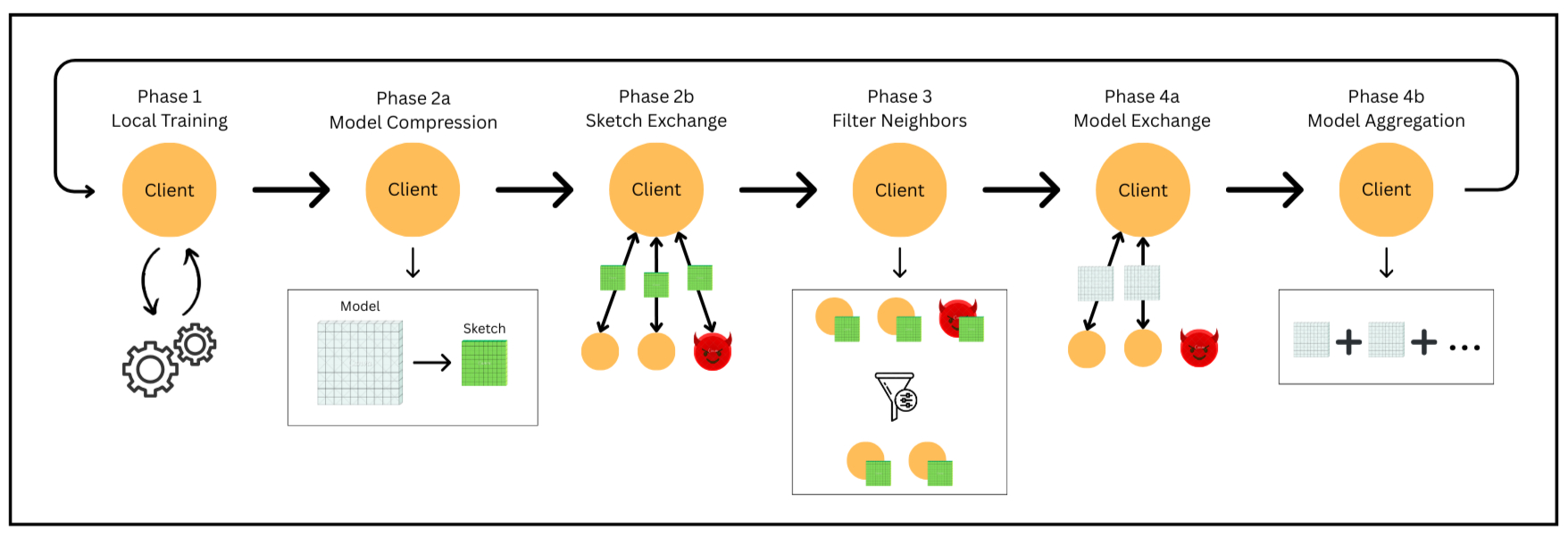
In decentralized federated learning, Byzantine-robust defenses filter neighbors by model similarity, but only after receiving each neighbor’s full model. On constrained edge uplinks, that transfer dominates the round, even for discarded models. We propose SketchGuard, which screens neighbors on compact sketches and fetches full models only from those that pass, so a rejected neighbor costs $O(k)$ rather than $O(d)$ where $k\ll d$. Sketches, however, hide information an adversary can exploit, either by building a model indistinguishable from a benign one under a public compressor or by forging a sketch once the seed is known. Three rules close these gaps, namely exact verification of every fetched model, commitment before the sketch seed is drawn, and a ban on any sender whose model mismatches its sketch. We prove convergence in the strongly convex and non-convex settings with explicit topology and heterogeneity terms. Across three datasets and two wrapped filters, SketchGuard reproduces the uncompressed filter’s test error to within $0.003$, withstands a band-targeted attack that defeats sketch-only screening, and moves $0.7\times$ the bytes of full exchange under attack for under $1.7%$ of a round in compute. On emulated edge and cloud links it cuts the round to $0.61\times$ that of the state-of-the-art.
Figure 1: The SketchGuard Protocol
Citation
@MISC{rangwala2025sketchguard,
      title={SketchGuard: Scaling Byzantine-Robust Decentralized Federated Learning via Sketch-Based Screening},
      author={Murtaza Rangwala and Farag Azzedin and Richard O. Sinnott and Rajkumar Buyya},
      year={2025},
      eprint={2510.07922},
      archivePrefix={arXiv},
      primaryClass={cs.LG},
      url={https://arxiv.org/abs/2510.07922},
}