Download
🎧 Podcast Summary
Listen to the narrated summary of the paper:
Abstract
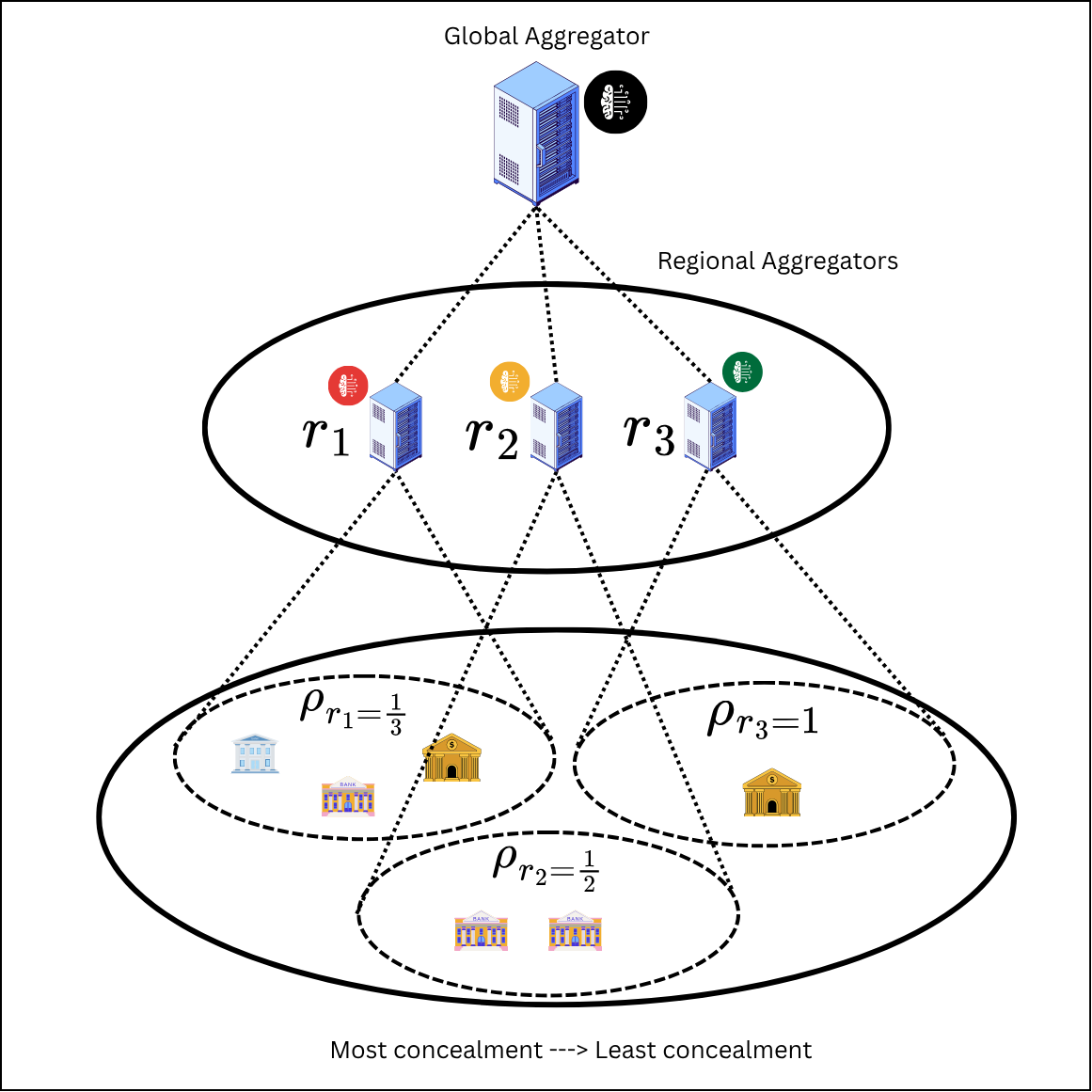
Hierarchical federated learning places regional aggregators between clients and the cloud, so a participant’s update is observed only alongside its neighbours’. The concealment this arrangement provides depends on the size of the aggregation region, and regions in operational deployments vary widely. Prevailing practice applies a single noise multiplier to every participant, calibrated for the most exposed region, so every other participant carries more noise than its own exposure requires. We show that this allocation problem admits an explicit solution. We first give a silo-level differential privacy guarantee for the mechanism, then bound the mutual information between a participant’s local class distribution and any estimate an observer positioned above the regional tier could form of it, using an adjacency notion matched to the quantity being protected. Minimising the worst-case bound under a fixed utility budget yields a min-max optimal allocation, which we call Fulcrum. The budget it recovers has a closed form we term the exposure dispersion, a measure of how unevenly aggregation weight is concentrated within regions relative to the most exposed one. Because this quantity follows from the region structure and the aggregation weights alone, a practitioner can evaluate it before training begins, and it vanishes precisely when all regions are equally exposed. On image and text classification at $\varepsilon = 0.99$, accuracy at a matched worst-case per-client guarantee improves by up to $14.84$ and $12.16$ percentage points where the dispersion is large, and is exactly zero on a balanced control for which the theory predicts parity.
Figure: Hierarchical Federated Learning
Citation
@misc{rangwala2026topologyawaredifferentialprivacyfederated,
      title={Topology-Aware Differential Privacy in Hierarchical Federated Learning},
      author={Murtaza Rangwala and Richard O. Sinnott and Rajkumar Buyya},
      year={2026},
      eprint={2506.19260},
      archivePrefix={arXiv},
      primaryClass={cs.CR},
      url={https://arxiv.org/abs/2506.19260},
}